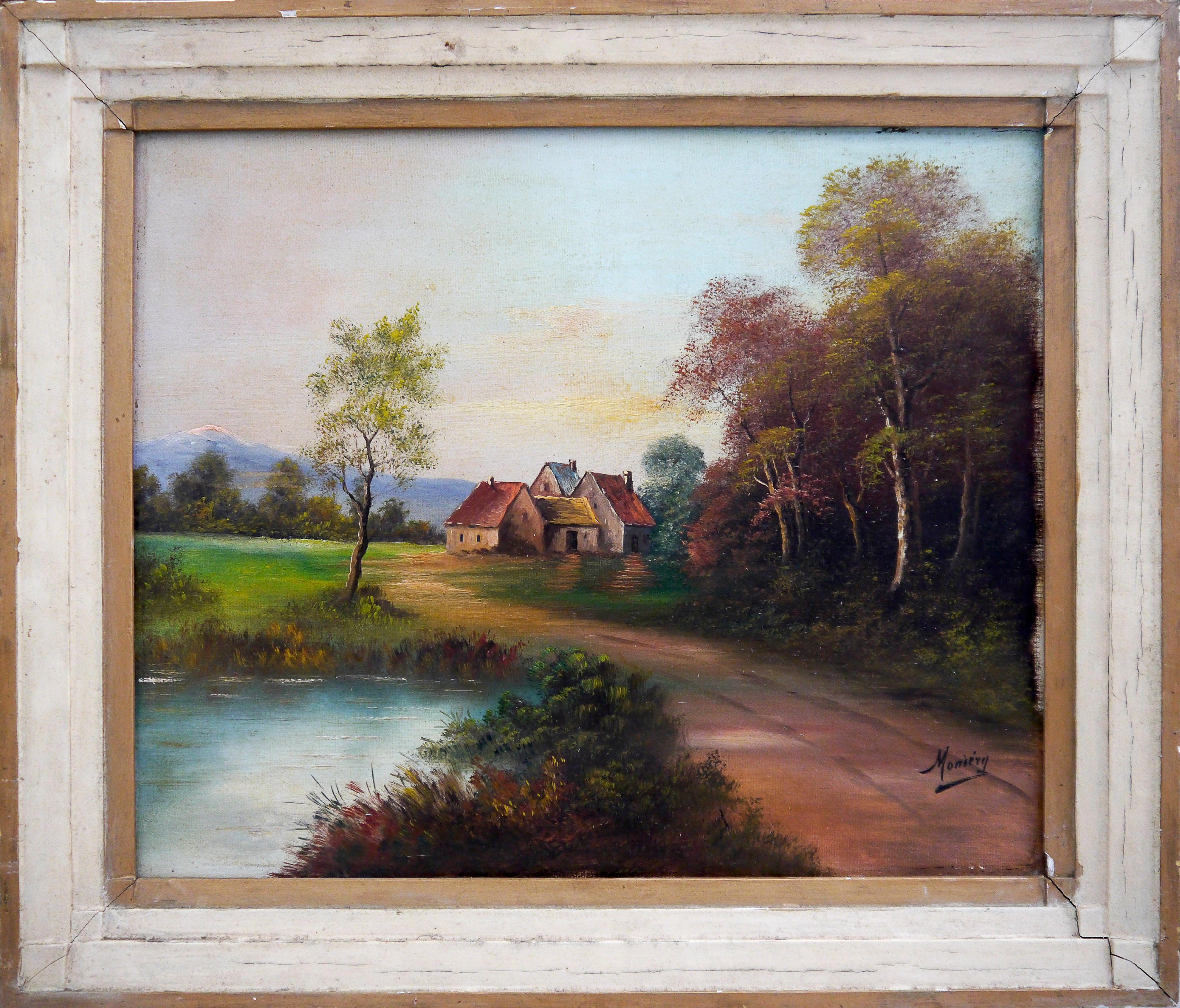
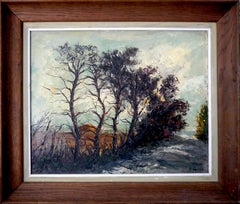
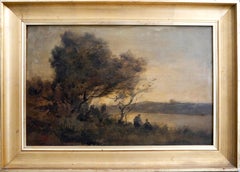
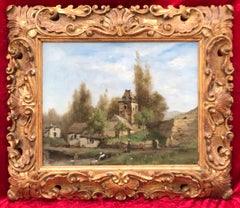
➡️ Landscape A Country Lane with Figures school of Barbizon⬅️
⏩It is signed - H Gomoh⏪
⭐Medium:⭐ Oil on canvas
⭐Technique: ⭐Impasto painting with expressive brushwork.
⭐Size:⭐55x46cm / 21.7x18.1 inch
with frame 68.5x59cm / 26.9x23.2 inch
⭐Date: probably end of 19th⭐
⭐Condition : ⭐ Good condition. NO cracks, beautiful. Frame is nice too.
⭐Provenance:⭐ Private collection - France.
⭐Shipping:⭐ from France is fast 4-6 days with Fedex / DHL
🟢🟢🟢🟢🟢🟢🟢🟢🟢🟢🟢🟢🟢🟢🟢🟢🟢🟢
About the painter:
From a stylistic perspective, the painting can be confidently dated to approximately 1895–1905. Its artistic language reflects the evolution of French landscape painting at the turn of the twentieth century, combining the naturalistic heritage of the Barbizon School with a growing sensitivity to light and atmosphere inherited from Impressionism. Although the artist's identity remains uncertain, the work displays notable affinities with the landscapes of Henri Saintin (1846–1899), Léon Germain Pelouse (1838–1891), Albert Rigolot (1862–1932), and Paul Désiré Trouillebert (1829–1900). Like these painters, the author favors poetic rural scenery, subtle atmospheric effects, and a harmonious balance between architecture and nature. However, the brushwork, composition, and handling of vegetation suggest that this is not the work of any of these artists, but rather that of a competent contemporary painter working within the same artistic tradition. Such stylistic affinities place the painting firmly within the flourishing French landscape school that remained highly appreciated by collectors during the Belle Époque.
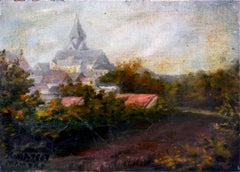
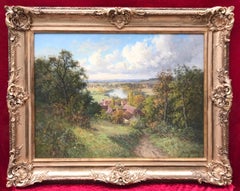
This charming oil painting represents a peaceful rural entrance leading toward an elegant country residence, most likely painted during the final decades of the nineteenth century or the opening years of the twentieth century. Although the exact location remains unknown, the architecture, vegetation, and atmosphere strongly suggest northern France or Belgium, regions where artists frequently celebrated the quiet beauty of country estates and village life.
The composition is carefully balanced. A winding dirt road occupies the foreground, naturally inviting the viewer into the painting. The eye follows this path toward a small ornamental pavilion surrounded by trees before finally reaching the imposing manor house, partially hidden by abundant foliage on the right. This gradual visual progression creates both depth and narrative, encouraging the spectator to imagine entering the estate.
The artist demonstrates a sophisticated understanding of perspective without relying on rigid architectural precision. Instead, the composition feels organic and alive, with the vegetation acting as a natural frame around the buildings.
One of the most attractive qualities of the painting is its treatment of light. Rather than depicting strong sunlight, the painter chose a soft, slightly overcast day. Large clouds diffuse the light evenly across the landscape, eliminating harsh shadows and producing a gentle atmospheric harmony. This subtle illumination allows the greens of the trees, the reddish roofs, and the pale earth of the road to coexist in perfect balance.
The foliage is undoubtedly the dominant feature of the composition. Different species of trees are distinguished through varied brushwork, ranging from delicate transparent leaves in the distance to richer, denser masses in the foreground. Small touches of white and pale yellow suggest sunlight catching the leaves, while scattered pink and red blossoms animate the garden without overwhelming it.
The painter's brushwork combines academic control with increasing freedom. The architecture is rendered with relative precision, while the vegetation becomes progressively looser and more spontaneous. This combination is characteristic of many landscape painters working between 1885 and 1910, when traditional realism began absorbing the lessons of Impressionism without abandoning recognizable forms.
Human presence remains discreet. A few tiny figures near the entrance bring life to the scene and provide scale. Rather than serving as portraits, these characters simply reinforce the impression that this is a peaceful inhabited estate. Their inclusion reflects a long French tradition in landscape painting, where everyday rural life complements rather than dominates nature.
Architecturally, the manor displays picturesque features fashionable during the late nineteenth century, including steep roofs and decorative timber framing reminiscent of Norman or Neo-Renaissance revival architecture. Such residences became popular among the bourgeoisie seeking country retreats during this period.
The colour palette is restrained yet highly effective. Greens dominate, ranging from cool bluish tones in the distant woodland to warmer olive and emerald hues in the foreground. Earthy browns, muted reds, soft greys, and creamy whites create an atmosphere of calm refinement. The painter avoids dramatic contrasts, preferring tonal harmony and atmospheric unity.
Technically, the artist appears comfortable working alla prima, particularly in the foliage where individual brushstrokes remain visible and energetic. The sky is treated with broader blended strokes, producing convincing cloud formations without excessive detail. This balance between finish and spontaneity reflects the practice of many accomplished provincial landscape painters active around the turn of the century.
From an art historical perspective, the painting belongs to the long tradition established by the Barbizon School, particularly artists such as Corot, Daubigny, and Trouillebert, whose influence continued well into the early twentieth century. Rather than depicting spectacular scenery, the artist celebrates the quiet poetry of ordinary rural life, emphasizing atmosphere, light, and seasonal freshness over dramatic narrative.