Want more images or videos?
Request additional images or videos from the seller.

Stanley Bate
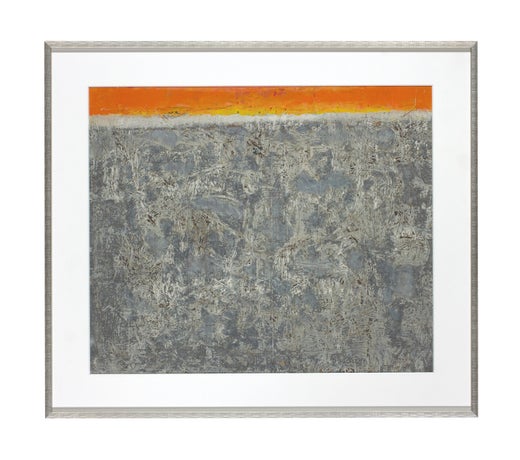
"Sunset, Gray Sea" Modern Abstract Painting

c. 1960

$5,850
£4,453.98
€5,327.92
CA$8,339.78
A$8,490.32
CHF 4,915.67
MX$112,096.96
NOK 54,947.12
SEK 58,632.94
DKK 39,963.39

About the Item

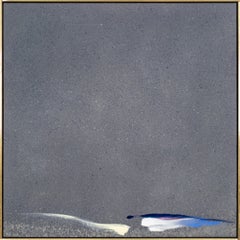
This original abstract painting by Stanley Bate is a striking exploration of texture, atmosphere, and restrained color, where a brilliant band of luminous orange crowns a richly layered field of silvery gray. Through countless gestural marks, scraped surfaces, and subtle tonal variations, Bate creates a composition that feels both ancient and contemporary—suggestive of weathered stone, distant landscapes, or memories preserved beneath time's surface. The painting's bold horizontal division establishes a powerful visual rhythm. Above, an intense horizon of glowing orange radiates warmth and energy; below, an expansive textured field of cool grays, soft taupes, and muted whites reveals extraordinary depth through intricate layering and expressive mark-making. The contrast between the vibrant upper register and the meditative lower expanse creates a quiet yet compelling tension. The painting itself is 16.75" x 19.75" and measures 22" x 25.25" x .375" framed. It is an unsigned piece by the artist. There is an estate stamp on the back and is framed in a frosted silver metal floater frame with a 2.25" acid-free off-white mat. It is ready to hang. Stanley Bate was born on March 26, 1903 in Nashville, Tennessee. The Bates were an established Tennessee family, in fact, Henry’s brother William Bate was the governor of Tennessee from 1883-1887 and a United States Senator from 1887-1905. Stanley studied art at the Watkins Institute in Nashville. In the 1920’s Bate moved to New York City to study at the Art Students League under Frederick Bridgman. He soon landed a job with Encyclopedia Britannica, and from 1927-1929 served as art editor. From 1929 until his death in 1972, Stanley was a self-employed artist. He taught art classes at both the Art Students League and the Albany Institute of History and Art and brought in extra income by making illustrations for magazines such as “Outdoor Life” and “Popular Science”. On January 27, 1934 Stanley married Emilie Rossel. Emilie had emigrated from Switzerland to New York in 1923. She found work as a governess to Alfred Vanderbilt and later as an executive secretary for Wall Street investment brokers Kahn, Loeb and Co. Emilie met Stanley in New York in the early 1930’s when she attended one of his art exhibitions with a friend. The couple, who had no children, lived on 34th Street in Manhattan. During this period, Bate was producing and exhibiting his art and joined several artists groups. Stanley and Emilie became part of the New York art scene, dining weekly at the Society of Illustrators Clubhouse. Stanley Bate’s time in New York was pivotal in the formation of his painting style. He lived in New York during the inception of one of the most important Modern Art movements, one that helped New York replace Paris as the center of avant-garde art. This movement, which was called the New York School of artists, was later known as Abstract Expressionism. It was comprised of a loosely associated group of vanguard artists working in New York City during the 1940s and 1950s. The New York School was not defined by a specific style, but instead reflected a fusion of European Modernism and American social relevancy that was depicted in many individual styles. Influences of Surrealism, Cubism, and Modernism can be found in their work, along with an interest in experimenting with non-traditional materials and methods. American art was in the forefront of international avant-garde for the first time. Stanley Bate was undoubtedly exposed to the varied styles and techniques that were emerging during the formative years of the New York School. Mark Rothko and Robert Motherwell were formulating their versions of color field paintings. Joseph Cornell was experimenting with assemblages, collage and the use of different types of textured paints. Jackson Pollock was adhering objects such as buttons and coins into his early works, while Louise Nevelson was using found objects. Helen Frankenthaler added sand to her early paintings. The New York School artists were undermining traditional fine art by using mixed media and non-traditional methods. Stanley Bate absorbed these varied influences and soon his early realistic landscapes and still-lifes were replaced with something entirely new. The influence of Cubism, notably the flat shallow space of the picture plane, is obvious in many of Bate’s paintings. Surrealism is evident in Bate’s use of subjects from myth, primitive art and antiquity, along with the Automatism-like line work in his more linear images. The unfettered experimentation of the New York School is everywhere in Stanley Bate’s work. We see nods to color field, collage, the mixing of textures into paint, mixed media, the inclusion of found objects and thick, luscious impasto. Bate was prolific and experimented in various media including oil, watercolor, lithography, silk screen, wood cut, drawing, collage, ceramics and sculpture. Bate is considered a true Modernist. His work is largely abstract, but sometimes figures and buildings are discernable. He frequently mixed paint, sand and glue together to achieve a textured surface, and then scraped and scratched through this layer to expose some of the underpainting below. His sculpture, which is often whimsical, also reflects the non-traditional methods of the New York School. Bate pioneered the use of enamel and copper in his work. The sculptures are not carved or modeled as was done in the past, but instead are built using mixed media and new materials. In addition to the New York School influence, many of Bate’s works exhibit a strong connection to the Spanish school, especially the work of Antonio Tapies and Modesto Cuixart. These artists were both part of an avant-garde group known as Art Informel, the Spanish equivalent of Abstract Expressionism. These artists likewise worked in mixed media and introduced objects and texture into their work. Many of Bate’s subjects and titles relate to Spanish locations and words. It is likely that Stanley spent time in Spain and found inspiration there. By the early 1940s, Stanley and Emilie had started spending weekends in a barn they purchased in Craryville, New York, a few hours north of Manhattan. The barn had no electricity or plumbing, but when the Bates eventually decided to leave New York and live full time in Craryville, they remodeled the barn, putting a gallery downstairs and a studio and living quarters upstairs. Although the Bates moved out of New York City, Stanley remained part of the New York art scene, exhibiting in New York and elsewhere throughout the 50s and 60s. During his lifetime he was represented by the New York galleries Knoedler and Company, Kennedy Galleries, Rose Fried Gallery and Key Gallery, along with Tyringham Gallery located in Tyringham, Massachusetts. Craryville was Stanley’s home until his death on August 21, 1972. Emilie died 1984. Her obituary requested that any donations to be made to the Albany Institute of History and Art. The Institute held a retrospective exhibition of Bate’s work in 1973. Since his death, Stanley Bate’s artwork has been exhibited widely and placed in numerous collections. About Sorelle Gallery: Sorelle Gallery is a woman-owned fine art gallery and art advisory firm located in Westport, Connecticut. Representing nearly fifty artists, Sorelle carries a wide variety of art styles from modern abstract to impressionistic landscapes, and more. Sorelle's mission is to not only support the emerging and established artists they represent, but to help clients curate their own spaces, invest confidently, and buy what they love.
  • Creator:
    Stanley Bate (1903 - 1972, American)
  • Creation Year:
    c. 1960
  • Dimensions:
    Height: 22 in (55.88 cm)Width: 25.25 in (64.14 cm)Depth: 0.375 in (9.53 mm)
  • Medium:
  • Movement & Style:
  • Period:
  • Condition:
  • Gallery Location:
    Westport, CT
  • Reference Number:
    Seller: SBA1071stDibs: LU54418469452

More From This Seller

View All
"The General II" Modern Abstract Painting

"The General II" Modern Abstract Painting

By Stanley Bate

Located in Westport, CT

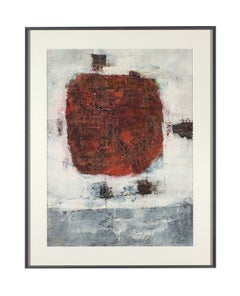
This original abstract painting by Stanley Bate is a compelling study in form, texture, and balance, centered around a monumental rust-red geometric shape that radiates quiet strengt...

Category

1960s Abstract Abstract Paintings

Materials

Paper, Gouache

"Untitled #144, " 1960s Modern Abstract Painting

"Untitled #144, " 1960s Modern Abstract Painting

By Stanley Bate

Located in Westport, CT

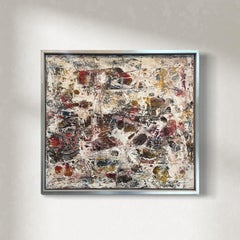
This Modern painting by Abstract Expressionist Stanley Bate was made with oil on canvas circa 1960. In it, layers of red, yellow, white, and umber paint are expressively applied over...

Category

1960s Modern Abstract Paintings

Materials

Canvas, Oil

"Picos, " 1970s Modern Abstract Painting

"Picos, " 1970s Modern Abstract Painting

By Stanley Bate

Located in Westport, CT

"Picos" is an abstract painting created in 1971 by Modernist artist, Stanley Bate. The piece features an earthy, muted palette, giving it a serene feeling with deep grey, muted brown...

Category

1970s Modern Abstract Paintings

Materials

Canvas, Oil

"Stele, " 1960s Modern Abstract Painting

"Stele, " 1960s Modern Abstract Painting

By Stanley Bate

Located in Westport, CT

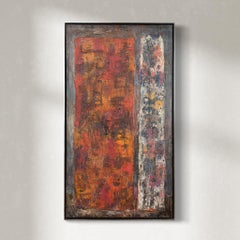
"Stele" by Modernist painter Stanley Bate is a bold painting with a dark grey and umber border and large, central rectangles, the left in a warm red and orange and the right in a lig...

Category

1960s Modern Abstract Paintings

Materials

Canvas, Oil

"Oracle, " 1970s Modern Abstract Painting

"Oracle, " 1970s Modern Abstract Painting

By Stanley Bate

Located in Westport, CT

This painting by Modernist painter Stanley Bate is almost monochromatic with dark brown, sandy tan and white geometric shapes. There is a single bright red pop of color at the almost...

Category

1970s Modern Abstract Paintings

Materials

Canvas, Oil

"Untitled #128, " 1960s Modern Abstract Painting

"Untitled #128, " 1960s Modern Abstract Painting

By Stanley Bate

Located in Westport, CT

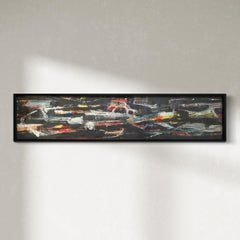
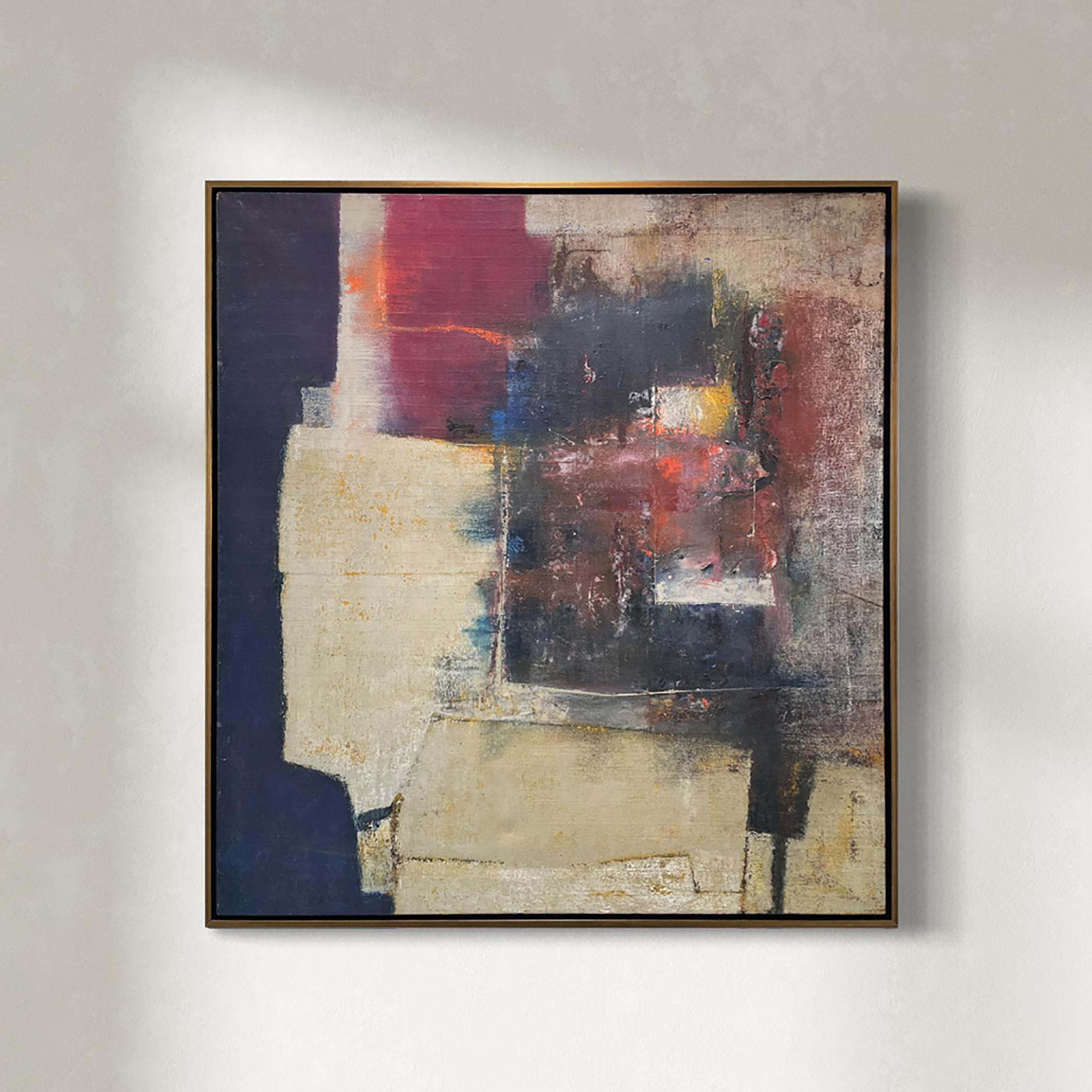
This Modern Abstract Expressionist painting by Stanley Bate is made with gouache on paper. It features a dark palette, with dark charcoal black tones contrasted by yellow and red accents throughout, and large brush strokes. The painting itself is 16" x 54" and measures 17" x 56" x 2" framed. The paper is mounted on board, framed in a black frame under glass. It is not signed by the artist, but has been authenticated by his estate, and is stamped with the estate seal on the back of the painting, and on the back of the frame. It is ready to hang. Stanley Bate was born on March 26, 1903 in Nashville, Tennessee. The Bates were an established Tennessee family, in fact, Henry’s brother William Bate was the governor of Tennessee from 1883-1887 and a United States Senator from 1887-1905. Stanley studied art at the Watkins Institute in Nashville. In the 1920’s Bate moved to New York City to study at the Art Students League under Frederick Bridgman. He soon landed a job with Encyclopedia Britannica, and from 1927-1929 served as art editor. From 1929 until his death in 1972, Stanley was a self-employed artist. He taught art classes at both the Art Students League and the Albany Institute of History and Art and brought in extra income by making illustrations for magazines such as “Outdoor Life” and “Popular Science”. On January 27, 1934 Stanley married Emilie Rossel. Emilie had emigrated from Switzerland to New York in 1923. She found work as a governess to Alfred Vanderbilt and later as an executive secretary for Wall Street investment brokers Kahn, Loeb and Co. Emilie met Stanley in New York in the early 1930’s when she attended one of his art exhibitions with a friend. The couple, who had no children, lived on 34th Street in Manhattan. During this period, Bate was producing and exhibiting his art and joined several artists groups. Stanley and Emilie became part of the New York art scene, dining weekly at the Society of Illustrators Clubhouse. Stanley Bate’s time in New York was pivotal in the formation of his painting style. He lived in New York during the inception of one of the most important Modern Art movements, one that helped New York replace Paris as the center of avant-garde art. This movement, which was called the New York School of artists, was later known as Abstract Expressionism. It was comprised of a loosely associated group of vanguard artists working in New York City during the 1940s and 1950s. The New York School was not defined by a specific style, but instead reflected a fusion of European Modernism and American social relevancy that was depicted in many individual styles. Influences of Surrealism, Cubism, and Modernism can be found in their work, along with an interest in experimenting with non-traditional materials and methods. American art was in the forefront of international avant-garde for the first time. Stanley Bate was undoubtedly exposed to the varied styles and techniques that were emerging during the formative years of the New York School. Mark Rothko and Robert Motherwell were formulating their versions of color field paintings. Joseph Cornell was experimenting with assemblages, collage and the use of different types of textured paints. Jackson Pollock was adhering objects such as buttons and coins into his early works, while Louise Nevelson was using found objects. Helen Frankenthaler added sand to her early paintings. The New York School artists were undermining traditional fine art by using mixed media and non-traditional methods. Stanley Bate absorbed these varied influences and soon his early realistic landscapes and still-lifes were replaced with something entirely new. The influence of Cubism, notably the flat shallow space of the picture plane, is obvious in many of Bate’s paintings. Surrealism is evident in Bate’s use of subjects from myth, primitive art and antiquity, along with the Automatism-like line work in his more linear images. The unfettered experimentation of the New York School is everywhere in Stanley Bate’s work. We see nods to color field, collage, the mixing of textures into paint, mixed media, the inclusion of found objects and thick, luscious impasto. Bate was prolific and experimented in various media including oil, watercolor, lithography, silk screen, wood cut, drawing, collage, ceramics and sculpture. Bate is considered a true Modernist. His work is largely abstract, but sometimes figures and buildings are discernable. He frequently mixed paint, sand and glue together to achieve a textured surface, and then scraped and scratched through this layer to expose some of the underpainting below. His sculpture, which is often whimsical, also reflects the non-traditional methods of the New York School. Bate pioneered the use of enamel and copper in his work. The sculptures are not carved or modeled as was done in the past, but instead are built using mixed media and new materials. In addition to the New York School influence, many of Bate’s works exhibit a strong connection to the Spanish school, especially the work of Antonio Tapies and Modesto Cuixart. These artists were both part of an avant-garde group known as Art Informel, the Spanish equivalent of Abstract Expressionism. These artists likewise worked in mixed media and introduced objects and texture into their work. Many of Bate’s subjects and titles relate to Spanish locations and words. It is likely that Stanley spent time in Spain and found inspiration there. By the early 1940s, Stanley and Emilie had started spending weekends in a barn they purchased in Craryville, New York, a few hours north of Manhattan. The barn had no electricity or plumbing, but when the Bates eventually decided to leave New York and live full time in Craryville, they remodeled the barn, putting a gallery downstairs and a studio and living quarters upstairs. Although the Bates moved out of New York City, Stanley remained part of the New York art scene, exhibiting in New York and elsewhere throughout the 50s and 60s. During his lifetime he was represented by the New York galleries Knoedler and Company, Kennedy Galleries, Rose Fried Gallery and Key Gallery, along with Tyringham Gallery located in Tyringham, Massachusetts. Craryville was Stanley’s home until his death on August 21, 1972. Emilie died 1984...

Category

1960s Modern Abstract Paintings
Materials

Paper, Gouache

You May Also Like

Xin Shen Abstract Original Oil On Canvas "Untitled"

Xin Shen Abstract Original Oil On Canvas "Untitled"

By Xin Shen

Located in New York, NY

Title: Untitled Medium: Oil on canvas Size: 19 x 15 inches Frame: Framing options available! Condition: The painting appears to be in excellent condition. Year: 2000 Circa A...

Category

21st Century and Contemporary Contemporary Abstract Paintings

Materials

Oil

Sunset 65, Painting, Acrylic on Canvas

Sunset 65, Painting, Acrylic on Canvas

By Hilary Winfield

Located in Yardley, PA

Sunset 65 is an original painting, created with acrylic paint on gallery-wrapped canvas. It has a width of 20 inches and a height of 20 inches with a depth of 1.5 inches (20x20x1.5)....

Category

2010s Abstract Abstract Paintings

Materials

Acrylic

Abstract Minimalist Skyscape Painting in Neutral Tones by Viktor Kobylianski

Abstract Minimalist Skyscape Painting in Neutral Tones by Viktor Kobylianski

By Viktor Kobylianski

Located in Barcelona, Barcelona

At Escat Gallery we are committed to maintaining the highest standards of trust and professionalism for our collectors. Every artwork in our collection comes with a Certificate of Au...

Category

2010s Abstract Abstract Paintings

Materials

Cotton Canvas, Mixed Media, Pigment

Gloaming: Abstract Oil Painting, 37.75 x 37.75, Signed

Gloaming: Abstract Oil Painting, 37.75 x 37.75, Signed

By Charles Robb

Located in Bloomfield, ON

This abstract painting is by Charles Robb, son of the famous Canadian artist Jack Bush. Charles Robb’s lyrical, expressive paintings are highly regarded by critics and collectors worldwide. Like his internationally celebrated father, abstract artist, Jack Bush, he was a consummate colourist who painted under the name, Charles Robb. Robb’s distinctive rhythmic style also reflected another lifelong passion—music—for he was a professional jazz drummer who liked to listen to music as he painted. He typically began each painting by building up layers of paint and vibrant markings, creating a richly textured surface with visible depth. His colour palette often featured intriguing choices and unusual colour combinations. Robb’s paintings...

Category

1980s Color-Field Abstract Paintings

Materials

Canvas, Acrylic

"Sunset", painting by Eva Ullrich (51x40in), 2019

"Sunset", painting by Eva Ullrich (51x40in), 2019

By Eva Ullrich

Located in Paris, France

"Sunset", acrylic on Canvas, multiple layers using brushes, squeegees and sponges, framed, by Eva Ullrich. Eva Ullrich is a landscape artist who's work leans more towards abstractio...

Category

2010s Abstract Abstract Paintings

Materials

Canvas, Acrylic

Umi 2 (Abstract Painting)

Umi 2 (Abstract Painting)

By Janise Yntema

Located in London, GB

Image size is 40 x 32 cm (15.7 x 12.6 in) matted to 61 x 51.x 0.1 cm (24 x 20.1 in) Janise Yntema’s practice is rooted in the mastery of wax-based media, ranging from traditional he...

Category

2010s Abstract Abstract Paintings

Materials

Paper, Mixed Media, Wax, Oil