Spanish Surrealist Metamorphic Figures, Cadaqués Costa Brava Oil Painting
Artist: Antoni Pitxot i Soler (Figueres, 1934–2015)
Title: Untitled (Metamorphic Figures)
Date: 2006
Medium: Oil on cardboard
Dimensions: 26 x 18 cm / 10.24 x 7.09 in
Signature: Signed and dated “Pitxot 06” lower left
Framing: Unframed
Provenance: Personally gifted and dedicated by the artist to Carmen and Ramon Boixadós in Cadaqués, December 2009
Inscription: Handwritten dedication on the reverse wishing the recipients a Merry Christmas and Happy New Year 2010. The artist initially wrote “2001” and immediately corrected it to “2010,” adding “perdon!”
Condition: Good original condition, with minor signs of age consistent with the technique and support
Style: Surrealism / Figurative Surrealism / Spanish Contemporary Art
Description
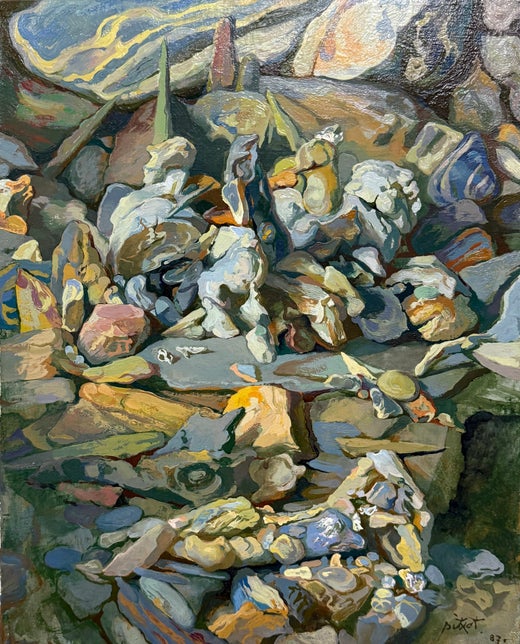
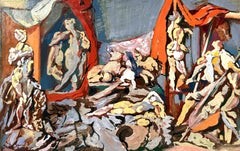
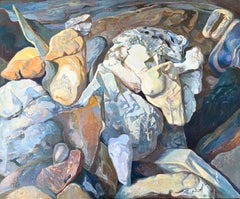
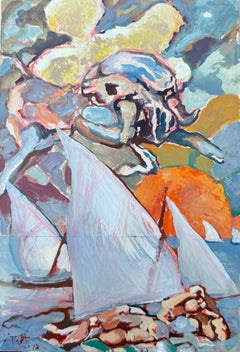
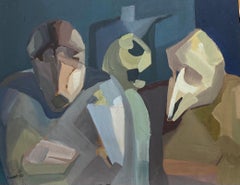
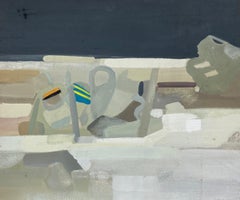
A highly characteristic and visually striking oil painting by Catalan artist Antoni Pitxot, created in 2006 during the artist’s mature period in Cadaqués. The work belongs to the unmistakable pictorial universe that made Pitxot one of the most singular representatives of Spanish and Catalan Surrealism and one of the artists most closely associated with Salvador Dalí.
The composition transforms stones and mineral forms into mysterious anthropomorphic figures. A monumental blue-grey presence dominates the painting, simultaneously suggesting a human body, a rocky formation and an imaginary sculpture. Around it, smaller fragments in orange, turquoise, ochre, violet and cream create an almost archaeological landscape populated by strange organic beings, while a large face emerges unexpectedly from the lower right.
This ambiguity between stone, body, landscape and portrait is central to Pitxot’s work. After settling permanently in Cadaqués, the artist became fascinated by the extraordinary geological landscape of the Costa Brava and especially Cap de Creus. Rather than simply imagining rocky figures, Pitxot collected stones from the landscape and physically arranged them into faces, bodies and fantastic constructions, which then served as models for his paintings.
The result is a distinctive form of Mediterranean Surrealism in which nature itself appears to undergo a process of metamorphosis. Rocks become bodies, bodies dissolve into landscape and apparently abstract formations suddenly reveal human features. The viewer is continually invited to discover new figures hidden within the composition.
The painting is executed with a richly textured surface and expressive brushwork. Areas of pronounced impasto reinforce the sculptural quality of the forms, while the contrast between muted blue-grey masses and vivid Mediterranean accents gives the small composition remarkable visual intensity.
Of particular interest is the exceptional direct provenance of the work. Pitxot painted it in 2006 and three years later personally gifted and dedicated it in Cadaqués to Carmen and Ramon Boixadós. The inscription on the reverse, dated December 2009, wishes them a Merry Christmas and Happy New Year 2010. Pitxot initially wrote “2001” before immediately correcting himself to “2010” with the handwritten word “perdon!”, an unusually intimate and charming documentary detail directly connecting the painting with the artist.
This is a particularly representative example of Pitxot’s mature production, combining Spanish Surrealism, Catalan figurative painting, the landscape of Cadaqués and Cap de Creus, metamorphic imagery and the artistic world surrounding Salvador Dalí.
Artistic Inspiration
Pitxot’s extraordinary mineral figures place his work within the great European tradition of Surrealist metamorphosis. His transformation of natural objects into human forms naturally recalls the double images and optical transformations of Salvador Dalí, while the dreamlike landscapes of Yves Tanguy and the organic inventions of Max Ernst provide important international parallels. There are also echoes of Giuseppe Arcimboldo’s centuries-old fascination with constructing human figures from unrelated natural elements. Yet Pitxot developed a language entirely his own, rooted not in an imaginary landscape but in the real stones, light and geology of Cadaqués and Cap de Creus. This profound connection with the Mediterranean gives his paintings an identity immediately recognizable within Spanish Surrealism.
Biography
Antoni Pitxot i Soler was born in Figueres, Catalonia, in 1934 into a distinguished family closely connected with the arts. His father, Ricard Pichot, was a cellist and pupil of Pau Casals, while his uncle Ramon Pichot was an important Catalan painter associated with Modernisme and the artistic circles of Paris.
Pitxot spent part of his youth in San Sebastián, where he studied drawing with Juan Núñez Fernández, who had also taught Salvador Dalí. His earliest paintings followed a relatively traditional figurative approach, but his artistic language changed profoundly after he settled permanently in Cadaqués during the 1960s.
The dramatic mineral landscape of Cadaqués and Cap de Creus became the central source of his mature work. Pitxot began collecting stones and arranging them into human figures, heads, mythological creatures and fantastic constructions before translating these temporary assemblages into paintings. Through this process he developed the distinctive metamorphic imagery for which he became internationally recognized.
His relationship with Salvador Dalí was both artistic and deeply personal. Dalí admired Pitxot’s work and invited him to participate in the creation of the Dalí Theatre-Museum in Figueres. Pitxot maintained a permanent exhibition within the museum and collaborated with Dalí on some of its characteristic installations. He later became one of Dalí’s closest companions during the final years of the artist’s life.
Pitxot subsequently served as director of the Dalí Theatre-Museum and as trustee and vice-president of the Gala-Salvador Dalí Foundation, playing an important role in preserving and interpreting Dalí’s artistic legacy.
In 2004 he received Spain’s Gold Medal of Merit in the Fine Arts. Antoni Pitxot died in 2015.
Antoni Pitxot, Spanish Surrealism, Catalan Surrealism, surrealist painting, figurative Surrealism, Salvador Dalí circle, Salvador Dalí collaborator, Cadaqués artist, Cadaqués painting, Costa Brava painting, Cap de Creus, Mediterranean art, Spanish contemporary painting, Catalan contemporary art, metamorphic painting, anthropomorphic figures, rock figures, surrealist figures, Spanish figurative art, oil on cardboard, signed Spanish painting, Mediterranean Surrealism, 21st century Spanish art, Catalan artist
Figurative Paintings
Surrealist Paintings
European art with a Mediterranean soul.