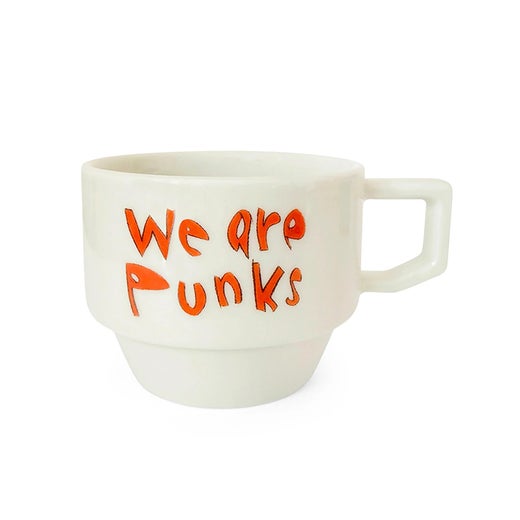
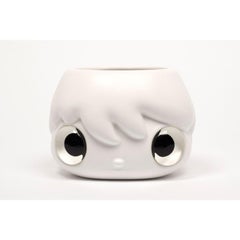
Yoshitomo Nara - We are punks Mug Small
Date of creation: 2011
Medium: Porcelain
Edition: Open
Size: 65 x Φ85 mm (200ml)
Condition: Brand new, inside its custom box
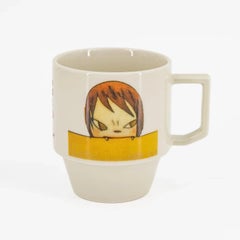
Description: A small porcelain mug based on Yoshitomo Nara's We Are Punks (2011), a colour-pencil drawing of a defiant, round-headed child whose expression falls somewhere between a lullaby and a battle cry. The piece belongs to a body of work where Nara channels the raw energy of the punk and folk records he grew up listening to on U.S. Armed Forces radio in rural Aomori, a thread that runs from his earliest sketchbooks to his large-scale canvases and limited editions.
Crafted in Hasami ware from Nagasaki Prefecture, the mug is dishwasher and microwave safe. The clay is fired and glazed in Japan using techniques passed down through four centuries of potters in the hills above Nagasaki. The result is a clean white body, light but solid in the hand, with a matte finish that lets the illustration sit naturally on the surface rather than floating under a layer of gloss.
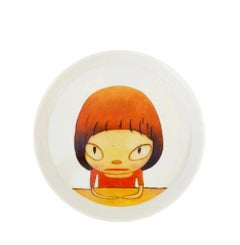
Peek inside once you have finished your espresso and you will find one of Nara's girls staring back at you from the bottom of the cup, as if she got there first and has no intention of leaving. It is a small, private encounter: exactly the kind of moment Nara builds into his work. His figures never perform for a crowd; they address you one-on-one, and finding one at the bottom of a coffee cup is about as intimate as it gets.
ABOUT THE ARTIST
Yoshitomo Nara (奈良美智, b. 1959, Hirosaki) is one of the most influential Japanese artists working today. Round-headed children with piercing gazes populate his canvases and sculptures, images that have gone well beyond the art world to become a broader cultural phenomenon.
Childhood in Aomori: Solitude, Nature, and Radio Waves
Nara grew up in Hirosaki, a small city in Aomori Prefecture at the northern tip of Honshū. Both parents worked long hours, leaving young Yoshitomo to fend for himself after school. The Japanese have a word for children like him, kagikko, latchkey kids who come home to an empty house and learn to keep their own company. That early acquaintance with solitude runs through every painting. Look at any of Nara's figures and you will find a self-contained being who meets your eye with a steadiness that could be courage or could just as easily be vulnerability.
During those solitary years, Western music reached him through the Far East Network (FEN), the U.S. Armed Forces radio station. Rock, folk, and later punk gave him a way to feel before painting ever did. As a young boy he bought his first record, Suzie Q, and has often said that album covers were his earliest art gallery. Later, he would design covers for Shonen Knife, R.E.M., and Bloodthirsty Butchers, and every exhibition he puts on is accompanied by a playlist of his own making.
Education: Aichi and the Kunstakademie Düsseldorf
After earning a BFA (1985) and MFA (1987) at the Aichi Prefectural University of Fine Arts and Music, Nara relocated to Germany to enrol at the Kunstakademie Düsseldorf, the same school that had shaped Joseph Beuys and Gerhard Richter. Under Neo-Expressionist painter A.R. Penck (1991–1993), he received one piece of advice that stuck: "Paint on the canvas as if you are drawing." Bold, pared-back figures, large rounded heads set against bare backgrounds, began to take shape on his canvases.
At the Kunstakademie's annual student show in 1992, visitors saw The Girl with the Knife in Her Hand (1991), a painting that crystallised the tension running through all of Nara's work: an apparently innocent girl holding a tiny knife, a gesture he reads not as aggression but as self-defence against a threatening adult world. Once finished with his studies, Nara settled in Cologne in 1994 and set up in a former cotton mill. Cut off by the language barrier, he turned painting into a conversation with himself, and it was in that solitude that the gaze people remember long after leaving the gallery first appeared.
Return to Japan and International Acclaim
Twelve years later, Nara came back to Japan. I DON'T MIND, IF YOU FORGET ME. opened at the Yokohama Museum of Art in 2001 and toured five Japanese venues, including Hirosaki. MoMA New York acquired 130 of his drawings around the same time, and the travelling retrospective Nothing Ever Happens (2003–2005) cemented his reputation in the United States. Within the Japanese "New Pop" wave, he shared the stage with artists such as Takashi Murakami, Makoto Aida, and Mariko Mori, though he always stood apart for a quieter, more autobiographical approach.
Nara and the Superflat Movement
Critics often link Nara to the Superflat movement theorised by Takashi Murakami, which collapses the distance separating classical Japanese art, manga and anime culture, and the aesthetics of global consumerism. Only partly accurate, the comparison overlooks a key difference. Murakami runs a near-corporate operation with large production teams. Nara works alone, and what he makes is closer to a diary entry, born in long hours of solitude at his Nasushiobara studio.
Yet Nara has engaged directly with Japanese artistic tradition. Working with craftsman Yasu Shibata (2010–2022), he produced mokuhanga, woodblock prints in the ukiyo-e tradition. As early as 1999, a sixteen-part series called In the Floating World fused punk motifs with Edo-period imagery. Younger artists such as Roby Dwi Antono openly acknowledge Nara's impact on their own practice.
The 2011 Earthquake and a Shift in Sensibility
Everything changed on 11 March 2011. The Great East Japan Earthquake, followed by the tsunami and the Fukushima nuclear disaster, shook Nara to the core. Back in Hirosaki, he and his mother gathered supplies for displaced families. Workshops followed, along with donated works for benefit auctions. But for months he could not paint at all. "I was so depressed that I couldn't help feeling that what I'd been doing was totally meaningless," he later recalled.
When the brushes finally came out again, something had shifted. Angry scowls gave way to contemplative, heavy-lidded faces. Layers of paint multiplied and colours grew softer. Pieces like Blankey (2012) and In the Milky Lake (2011) capture this new register: rebellion has stepped back, and a loaded, restful serenity has taken its place.
Beyond Painting
Painting and drawing sit at the core of what Nara does, but he also makes sculpture in wood, fibreglass, bronze, and ceramic, along with room-sized installations, huts, cabins, and small rooms built as shelters for looking at art up close. A 2007 residency in Shigaraki, home to one of Japan's six ancient kilns, opened a new direction: clay pieces that are rough and tactile, showing the hand that shaped them. Photography plays a part too. A 2002 trip to Afghanistan produced a photographic essay that underlined the pacifist thread running through all of it.
Recent Exhibitions and Legacy
Over the past few years Nara has headlined retrospectives at LACMA in Los Angeles (2021), the Albertina Modern in Vienna (2023), and the Guggenheim Museum Bilbao (2024), which travelled on to the Museum Frieder Burda and the Hayward Gallery in London. On the market, Knife Behind Back (2000) fetched roughly 25 million USD at Sotheby's Hong Kong in 2019, making him the most expensive Japanese artist at auction. TIME named him one of the 100 most influential people in the world in 2025.
Now sixty-six, Nara lives and works in Nasushiobara, Tochigi Prefecture. In 2018 he opened N's YARD there, a small exhibition space that doubles as an extension of his studio. Far from Tokyo, he goes on making work that, for all its simplicity, stops people in their tracks. One look at those big, knowing eyes and you get the feeling, hard to pin down yet impossible to shake, that the gaze is somehow familiar.