Video Loading
Want more images or videos?
Request additional images or videos from the seller.

Unknown
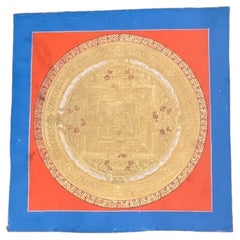
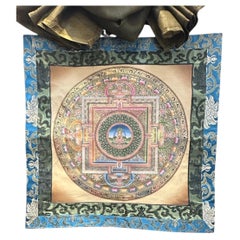
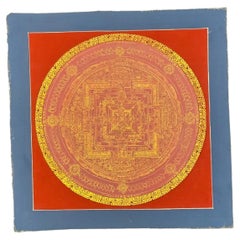
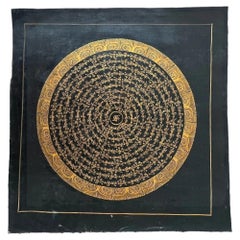
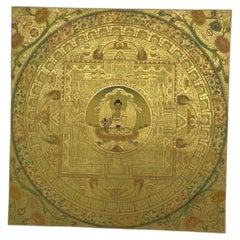
Framed Hand Painted on Canvas Mandala Thangka 24K Gold

1995

$3,800
$4,75020% Off
£2,894.21
£3,617.7620% Off
€3,463.37
€4,329.2220% Off
CA$5,415.68
CA$6,769.6020% Off
A$5,505.44
A$6,881.8020% Off
CHF 3,185.99
CHF 3,982.4920% Off
MX$73,187.83
MX$91,484.7920% Off
NOK 35,745.73
NOK 44,682.1620% Off
SEK 38,076.76
SEK 47,595.9520% Off
DKK 25,884.20
DKK 32,355.2520% Off

About the Item

This framed "Mandala" thangka is hand painted on canvas with 24K real gold. Earthy color tones and touch of gold makes it a stunning piece of artwork. Measurement of art without the frame: 29" x 22" A handout on process of making a thangka will be included with the purchase. Mandala represents "wholeness" and is also used as an aid in meditation. The term mandala has become a generic way of describing any circular geometric pattern. The word mandala originated from Sanskrit which means “Circle”. Early versions of the Mandala can be found in the Hindu faith where we would see geometric shapes representing deities. Buddhism took this concept one step further and today if you speak to someone in the Buddhist faith they will tell you that these paintings are in essence a 3 dimensional celestial palace with rooms that contains deities. Let’s call this a mind map, a map to help us further our spiritual journey. Our collection will focus almost entirely on Buddhist Mandalas, a Mandala by Buddhist standards will respect certain basic rules of composition and geometric proportion, although each painting you see is unique in its own way, we will try and cover some of these basic iconographic rules. A Mandala almost always consists of two elements, an outer circle combined with a square positioned inside. In most cases these circles or rings create a pure space protected from external impurities and negative forces. The number of these circles can differ from one painting to another. In almost all mandalas the outermost circle will show flames which commonly represents protection and the innermost circle with be lotus petals which is the Buddhist symbol for purity. This imagery is typical of Mandalas and Thangkas in general which is why almost all deities are seated on lotus thrones. The square represents this symbolic palace or mind map, which is mentioned in the previous section. Any Mandala will always contain a principle deity it can be painted or symbolized by a lotus flower in the case of the Kalachakra Mandala. This palace can contain any number of deities, but will always contain a principle deity which is always in the very center of the painting. Usually this deity is at the root of your practice. The Mandala acts as a guide to aid our meditative practice, it is through focus and meditation that we are able to access this celestial palace. On each side of the square in the four cardinal directions, there is an entrance to the Mandala. This is our access to this celestial world, a teacher or guru will help guide you through the palace until you can visualize each part. In certain cases there are figures above and below the mandala, these are the representations of the celestial world and our world. Mandalas are used by practitioners as an object of focus. Presence of a Mandala painting in a room creates a vibe of peace and calmness in the room.
  • Creation Year:
    1995
  • Dimensions:
    Height: 40 in (101.6 cm)Width: 33 in (83.82 cm)Depth: 1.5 in (3.81 cm)
  • Medium:
  • Period:
  • Condition:
  • Gallery Location:
    TRUMBULL, CT
  • Reference Number:
    Seller: MAN- LG1stDibs: LU1426213922282

More From This Seller

View All
Framed Hand Painted on Canvas Mandala Thangka 24K gold

Framed Hand Painted on Canvas Mandala Thangka 24K gold

Located in TRUMBULL, CT

This framed "Mandala" thangka is hand painted on canvas with 24K real gold. Earthy tones of color marries perfectly with matt black and touches of gold gives it a beautiful look. Measurement of art without the frame: 15" x 11" A handout on process of making a thangka will be included with the purchase. Mandala represents "wholeness" and is also used as an aid in meditation. The term mandala has become a generic way of describing any circular geometric pattern. The word mandala originated from Sanskrit which means “Circle”. Early versions of the Mandala can be found in the Hindu faith where we would see geometric shapes representing deities. Buddhism took this concept one...

Category

1980s Other Art Style Figurative Paintings

Materials

Mixed Media

Framed Hand Painted Mandala Thangka on Canvas with 24K Gold

Framed Hand Painted Mandala Thangka on Canvas with 24K Gold

Located in TRUMBULL, CT

This beautifully framed Mandala thangka is meticulously hand-painted on canvas, adorned with 24K real gold. The blue, ochre and green tones, complemented by the touch of gold, make ...

Category

21st Century and Contemporary Other Art Style Figurative Paintings

Materials

Mixed Media

Framed Hand Painted Mandala Thangka on Canvas with 24K Gold

Framed Hand Painted Mandala Thangka on Canvas with 24K Gold

Located in TRUMBULL, CT

This framed "Mandala" thangka is hand painted on canvas with 24K real gold. Earthy color tones and touch of gold makes it a stunning piece of artwork. Measurement of art without the frame: 14.25 X 11.25 inches. A handout on process of making a thangka will be included with the purchase. Mandala represents "wholeness" and is also used as an aid in meditation. The term mandala has become a generic way of describing any circular geometric pattern. The word mandala originated from Sanskrit which means “Circle”. Early versions of the Mandala can be found in the Hindu faith where we would see geometric shapes representing deities. Buddhism took this concept one step further and today if you speak to someone in the Buddhist faith they will tell you that these paintings are in essence a 3 dimensional celestial palace with rooms that contains deities. Let’s call this a mind map, a map to help us further our spiritual journey. Our collection will focus almost entirely on Buddhist Mandalas, a Mandala by Buddhist standards will respect certain basic rules of composition and geometric proportion, although each painting you see is unique in its own way, we will try and cover some of these basic iconographic rules. A Mandala almost always consists of two elements, an outer circle combined with a square positioned inside. In most cases these circles or rings create a pure space protected from external impurities and negative forces. The number of these circles can differ from one painting to another. In almost all mandalas the outermost circle will show flames which commonly represents protection and the innermost circle with be lotus petals which is the Buddhist symbol for purity. This imagery is typical of Mandalas and Thangkas in general which is why almost all deities are seated on lotus thrones. The square represents this symbolic palace or mind map, which is mentioned in the previous section. Any Mandala will always contain a principle deity it can be painted or symbolized by a lotus flower in the case of the Kalachakra Mandala...

Category

1980s Other Art Style Figurative Paintings

Materials

Mixed Media

Framed Hand Painted Mandala Thangka on Canvas with 24K Gold

Framed Hand Painted Mandala Thangka on Canvas with 24K Gold

Located in TRUMBULL, CT

This framed "Mandala" thangka is hand painted on canvas with 24K real gold. Ornate frame and seven mandalas make it a unique piece. Earthy color tones and touch of gold makes it a stunning piece of artwork. Measurement of art without the frame: 19" x 14" A handout on process of making a thangka will be included with the purchase. Mandala represents "wholeness" and is also used as an aid in meditation. The term mandala has become a generic way of describing any circular geometric pattern. The word mandala originated from Sanskrit which means “Circle”. Early versions of the Mandala can be found in the Hindu faith where we would see geometric shapes representing deities. Buddhism took this concept one step further and today if you speak to someone in the Buddhist faith they will tell you that these paintings are in essence a 3 dimensional celestial palace with rooms that contains deities. Let’s call this a mind map, a map to help us further our spiritual journey. Our collection will focus almost entirely on Buddhist Mandalas, a Mandala by Buddhist standards will respect certain basic rules of composition and geometric proportion, although each painting you see is unique in its own way, we will try and cover some of these basic iconographic rules. A Mandala almost always consists of two elements, an outer circle combined with a square positioned inside. In most cases these circles or rings create a pure space protected from external impurities and negative forces. The number of these circles can differ from one painting to another. In almost all mandalas the outermost circle will show flames which commonly represents protection and the innermost circle with be lotus petals which is the Buddhist symbol for purity. This imagery is typical of Mandalas and Thangkas in general which is why almost all deities are seated on lotus thrones. The square represents this symbolic palace or mind map, which is mentioned in the previous section. Any Mandala will always contain a principle deity it can be painted or symbolized by a lotus flower in the case of the Kalachakra Mandala...

Category

21st Century and Contemporary Other Art Style More Art

Materials

Mixed Media

Framed Five Mandala Original Hand Painted Thangka  With Real 24 Karat Gold

Framed Five Mandala Original Hand Painted Thangka With Real 24 Karat Gold

Located in TRUMBULL, CT

This mandala thangka is hand painted on canvas with 24k gold. Different hues of gray,dark green ,Black and peach colors blend seamlessly with the shimmering of real gold. The measure...

Category

Mid-20th Century Other Art Style More Art

Materials

Mixed Media

Framed Hand Painted  on Canvas Mandala Thangka 24K Gold

Framed Hand Painted on Canvas Mandala Thangka 24K Gold

Located in TRUMBULL, CT

This framed "Mandala" thangka is hand painted on canvas with 24K real gold. Golden Mandala and other figurative depiction on black background and red border makes it an incredible piece. Measurement of art without the frame: 12" x 17" A handout on process of making a thangka will be included with the purchase. Mandala represents "wholeness" and is also used as an aid in meditation. The term mandala has become a generic way of describing any circular geometric pattern. The word mandala originated from Sanskrit which means “Circle”. Early versions of the Mandala can be found in the Hindu faith where we would see geometric shapes representing deities. Buddhism took this concept one...

Category

1990s Other Art Style More Art

Materials

Mixed Media

You May Also Like

Late 20th C Tibetan Kalachakra Mandala Hand-Painted Thangka, Namgyal Monastery

Late 20th C Tibetan Kalachakra Mandala Hand-Painted Thangka, Namgyal Monastery

Located in Nottingham, GB

A finely executed late 20th-century Tibetan Buddhist Kalachakra Mandala, traditionally associated with Namgyal Monastery in Tibet and described as handmade by young monks. Entirely ...

Category

Late 20th Century Paintings and Screens

Materials

Canvas, Paint

Late 20th Century Tibetan Buddha Mandala Thangka with Gold and Silk Brocade

Late 20th Century Tibetan Buddha Mandala Thangka with Gold and Silk Brocade

Located in Nottingham, GB

A finely detailed late 20th-century Buddhist mandala thangka, stated to have been found at Tabo Monastery in Spiti, India, one of the most historically significant centres of Himalayan Buddhist art and learning. Hand-painted on canvas using gold together with traditional rock and mineral pigments, the composition is constructed around an intricate geometric mandala, with a seated Buddha occupying the central sacred space. The painting is presented within an elaborate traditional silk brocade mounting, combining rich burgundy, blue, green and gold textiles with long red hanging ribbons and a protective upper veil. The mandala is one of the most important visual structures within Himalayan Buddhist art. Conceived as both a representation of the enlightened universe and a symbolic palace, its carefully ordered geometry provides a visual framework for meditation, contemplation and ritual practice. At the centre sits the Buddha in meditation, surrounded by a radiating circular arrangement and successive architectural enclosures. The square palace structure and its directional gateways are contained within further concentric bands of ornament, creating a progression from the external world toward the sacred centre. This movement toward the central Buddha symbolically parallels the practitioner's journey from ordinary perception toward enlightened awareness. The exceptional level of miniature detailing is enhanced by the extensive use of gold, creating a luminous surface against the more restrained mineral colours. Pink, green, blue and red accents articulate the gateways, lotus motifs and architectural elements while maintaining the highly symmetrical structure characteristic of traditional mandala painting. Both a devotional object and an intricate example of Himalayan Buddhist painting, the work has considerable decorative presence when displayed in its complete textile mounting. Period: Late 20th Century Origin: Himalayan region / Spiti, India Provenance: Stated to have been found at Tabo Monastery, Spiti Subject: Buddha Mandala...

Category

Late 20th Century Paintings and Screens

Materials

Brocade, Canvas, Paint
Late 20th C Tibetan Kalachakra Mandala Hand-Painted Thangka, Namgyal Monastery

Late 20th C Tibetan Kalachakra Mandala Hand-Painted Thangka, Namgyal Monastery

Located in Nottingham, GB

A finely executed late 20th-century Tibetan Buddhist Kalachakra Mandala, traditionally associated with Namgyal Monastery in Tibet and described as handmade by young monks. Entirely ...

Category

Late 20th Century Paintings and Screens

Materials

Canvas, Paint

Late 20thC Tibetan Gold Om Mantra Mandala Hand-Painted Thangka Namgyal Monastery

Late 20thC Tibetan Gold Om Mantra Mandala Hand-Painted Thangka Namgyal Monastery

Located in Nottingham, GB

A striking late 20th-century Tibetan Buddhist Gold Om Mantra Mandala, traditionally associated with Namgyal Monastery in Tibet. Entirely handmade on prepared canvas, the composition...

Category

Late 20th Century Paintings and Screens

Materials

Canvas, Paint

Late 20th Century Medicine Buddha 24K Gold Hand-Painted Mandala Thangka, Spiti

Late 20th Century Medicine Buddha 24K Gold Hand-Painted Mandala Thangka, Spiti

Located in Nottingham, GB

A finely executed late-20th-century Tibetan Buddhist thangka depicting the Medicine Buddha, Bhaisajyaguru, stated to have been found at Kee Monastery in the Spiti Valley, India. Han...

Category

Late 20th Century Paintings and Screens

Materials

Canvas, Paint

Late 20th C Tibetan Kalachakra Mandala Hand-Painted Thangka, Namgyal Monastery

Late 20th C Tibetan Kalachakra Mandala Hand-Painted Thangka, Namgyal Monastery

Located in Nottingham, GB

A finely executed late 20th-century Tibetan Buddhist Kalachakra Mandala, traditionally associated with Namgyal Monastery in Tibet and described as handmade by young monks. Entirely ...

Category

Late 20th Century Paintings and Screens

Materials

Canvas, Paint