Want more images or videos?
Request additional images or videos from the seller.

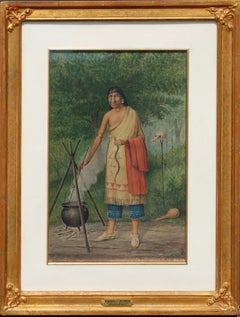
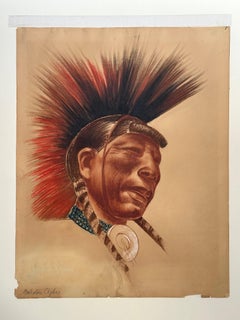
Winold Reiss
Indian Man from Mexico

1920

$85,000
£64,948.79
€77,649.47
CA$123,111.66
A$126,049.75
CHF 71,592.79
MX$1,612,008.94
NOK 823,553.68
SEK 855,781.37
DKK 580,438.29

About the Item

Indian Man from Mexico is a souvenir of Winold Reiss’s 1920 sketching tour of Mexico. As he traveled, Reiss’s style began to reflect the influence of the aesthetics, color palette, and patterns of indigenous American visual culture. He blended this into his by now hyphenated German American vocabulary, reaching for an artistic language expressed in universally accessible terms that would convey the respect he felt for all his subjects. Mexico proved inspirational to Reiss: his experience there offers insight into his subsequent work as a portraitist. He found, in Mexico’s scenery and its indigenous people, echoes of his beloved Black Forest.
  • Creator:
    Winold Reiss (1886-1953, American)
  • Creation Year:
    1920
  • Dimensions:
    Height: 25 in (63.5 cm)Width: 19 in (48.26 cm)
  • Medium:
  • Movement & Style:
  • Period:
  • Condition:
  • Gallery Location:
    New York, NY
  • Reference Number:
    Seller: APG 89601stDibs: LU2315670602

More From This Seller

View All
Rosalee Sondheimer I

Rosalee Sondheimer I

By Winold Reiss

Located in New York, NY

Winold Reiss (1886-1953), who scholars increasingly recognize as a pivotal figure in early 20th-century American art, is known for his evocative portraits that capture the spirit and...

Category

20th Century American Modern Portrait Drawings and Watercolors

Materials

Pastel, Board

Untitled

Untitled

By Charles Houghton Howard

Located in New York, NY

Charles Houghton Howard was born in Montclair, New Jersey, the third of five children in a cultured and educated family with roots going back to the Massachusetts Bay colony. His father, John Galen Howard, was an architect who had trained at M.I.T. and the École des Beaux-Arts in Paris and apprenticed in Boston with Henry Hobson Richardson. In New York, the elder Howard worked for McKim, Mead and White before establishing a successful private practice. Mary Robertson Bradbury Howard, Charles’s mother, had studied art before her marriage. John Galen Howard moved his household to California in 1902 to assume the position of supervising architect of the new University of California campus at Berkeley and to serve as Professor of Architecture and the first Dean of the School of Architecture (established in 1903). The four Howard boys grew up to be artists and all married artists, leaving a combined family legacy of art making in the San Francisco Bay area that endures to this day, most notably in design, murals, and reliefs at the Coit Tower and in buildings on the Berkeley campus. Charles Howard graduated from the University of California at Berkeley in 1921 as a journalism major and pursued graduate studies in English at Harvard and Columbia Universities before embarking on a two-year trip to Europe. Howard went to Europe as a would-be writer. But a near-religious experience, seeing a picture by Giorgione in a remote town outside of Venice, proved a life-altering epiphany. In his own words, “I cut the tour at once and hurried immediately back to Paris, to begin painting. I have been painting whenever I could ever since” (Charles Howard, “What Concerns Me,” Magazine of Art 39 [February 1946], p. 63). Giorgione’s achievement, in utilizing a structured and rational visual language of art to convey high emotion on canvas, instantly convinced Howard that painting, and not literature, offered the best vehicle to express what he wanted to say. Howard returned to the United States in 1925, confirmed in his intent to become an artist. Howard settled in New York and supported himself as a painter in the decorating workshop of Louis Bouché and Rudolph Guertler, where he specialized in mural painting. Devoting spare time to his own work, he lived in Greenwich Village and immersed himself in the downtown avant-garde cultural milieu. The late 1920s and early 1930s were the years of Howard’s art apprenticeship. He never pursued formal art instruction, but his keen eye, depth of feeling, and intense commitment to the process of art making, allowed him to assimilate elements of painting intuitively from the wide variety of art that interested him. He found inspiration in the modernist movements of the day, both for their adherence to abstract formal qualities and for the cosmopolitan, international nature of the movements themselves. Influenced deeply by Surrealism, Howard was part of a group of American and European Surrealists clustered around Julien Levy. Levy opened his eponymously-named gallery in 1931, and rose to fame in January 1932, when he organized and hosted Surrealisme, the first ever exhibition of Surrealism in America, which included one work by Howard. Levy remained the preeminent force in advocating for Surrealism in America until he closed his gallery in 1949. Howard’s association with Levy in the early 1930s confirms the artist’s place among the avant-garde community in New York at that time. In 1933, Howard left New York for London. It is likely that among the factors that led to the move were Howard’s desire to be a part of an international art community, as well as his marriage to English artist, Madge Knight...

Category

20th Century American Modern Abstract Drawings and Watercolors

Materials

Paper, Watercolor, Gouache, Graphite
Girl in Decorative Wrap

Girl in Decorative Wrap

By Winold Reiss

Located in New York, NY

Winold Reiss (1886-1953), who scholars increasingly recognize as a pivotal figure in early 20th-century American art, is known for his evocative portraits that capture the spirit and...

Category

20th Century American Modern Portrait Drawings and Watercolors

Materials

Mixed Media, Board

Japanese Girl

Japanese Girl

By Winold Reiss

Located in New York, NY

Signed (at lower right): WINOLD/REISS

Category

20th Century American Modern Portrait Drawings and Watercolors

Materials

Pastel

You May Also Like

Native American Man - V, Modern Ink and Pastel on Paper by Ira Moskowitz

Native American Man - V, Modern Ink and Pastel on Paper by Ira Moskowitz

By Ira Moskowitz

Located in Long Island City, NY

Ira Moskowitz, Polish/American (1912 - 2001) - Native American Man - V, Year: circa 1989, Medium: Ink and Pastel on Paper, signed, Size: 13 in. x 10 in. (33.02 cm x 25.4 cm), Descr...

Category

1980s Modern Portrait Drawings and Watercolors

Materials

Ink, Pastel

Medicine Man

Medicine Man

By Cassilly Adams

Located in Missouri, MO

Cassilly Adams (American 1843-1921) "Medicine Man" c. 1860s Watercolor on Paper Unsigned Provenance: Questroyal Gallery, NYC Site Size: approx. 14.5 x 8....

Category

Mid-19th Century American Realist Figurative Drawings and Watercolors

Materials

Paper, Watercolor

Man in Sombrero - II, Modern Ink on Paper by Ira Moskowitz

Man in Sombrero - II, Modern Ink on Paper by Ira Moskowitz

By Ira Moskowitz

Located in Long Island City, NY

Ira Moskowitz, Polish/American (1912 - 2001) - Man in Sombrero - II, Year: circa 1989, Medium: Ink on Paper, signed, Size: 13 in. x 10 in. (33.02 cm x 25.4 cm), Description: Sittin...

Category

1980s Modern Portrait Drawings and Watercolors

Materials

Ink

Un Hombre Primitivo

Un Hombre Primitivo

By Francisco Franklin

Located in Los Angeles, CA

Un Hombre Primitivo Francisco Franklin Color pencil on paper 1987 Hand signed "Francisco, 1987" in pencil. 18 inches H. X 24 inches W., 24.25 inches H. x 29.75 inches W. in artist's hand carved frame. A wonderful mid career example of this artist's work. This work is in excellent original condition, the paper is crisp and the colors rich. The artist's hand carved and hand painted frame appears with a couple dings. Frank Francisco Franklin is an American artist whose roots are strongly linked with those of the Mexican people...

Category

Late 20th Century Folk Art Drawings and Watercolor Paintings

Materials

Paper, Pencil

Taos (Timeless Ritual) Native American 1939 Indian Portrait Drawing

Taos (Timeless Ritual) Native American 1939 Indian Portrait Drawing

Located in Wilton Manors, FL

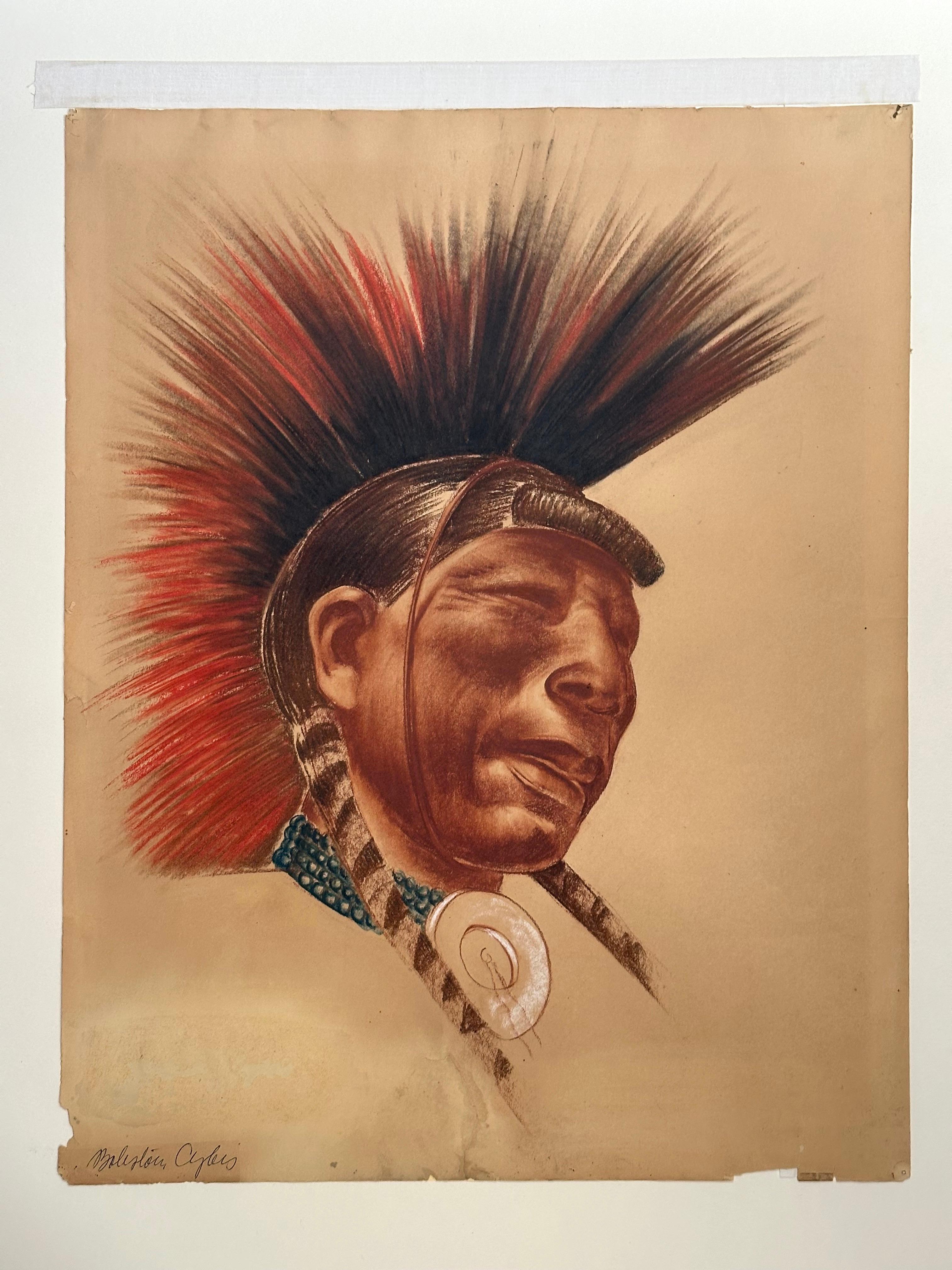
Boleslaw Cybis (1895-1957). Taos (Timeless Ritual), Indian Negro Series, 6 of 18. Conte on paper, sheet measures 18 x 23 inches. Small tear in sheet left margin. Evidence of alteration of image lower left where writing was probably removed before photographs require to create lithograph. The area has oxidized consequently. Signed by the artist some years after its creation in blue ink, lower left, ca. 1950's. the sheet is hinged at top margin, not glued down to backing board. Provenance: Cybis Archive. This original drawing was created in 1939-40 during an extensive visit to the Southwest US. The artist created 18 portraits and titled the series "Indian Negro Serie". Of the 18 images, 9 were selected to be included in a limited edition lithographic series some 30 years after creation. 1000 editions were printed. This is the original drawing upon which one of the images is based, and is thus unique. Of the 18 original drawings, 2 are owned by the polish government, 5 are in our collection and the other 11 are whereabouts unknown. The artist and his wife opened a porcelain factory in the 1950's, Cybis Studios. The only non-porcelain retail offering from the Cybis studio was a 1970s art issue called the Folio One. This was a limited edition reproduction series taken from nine conté drawings of Native Americans made by Boleslaw Cybis in 1939. Conté is the name of a type of crayon made of compressed charcoal or graphite mixed with wax or clay. The artist Georges Seurat was particularly fond of using conté for his drawings. Boleslaw Cybis was fascinated by the Native American (then typically referred to as American Indian) culture and peoples. This may seem odd when you consider that much of his ceramic-based works were distinctly Rococo and/or Old World European in style….a pretty stark contrast, I’d say! But Cybis was nothing if not eclectic in his tastes. The originals were reproduced as color lithographs, in an edition of 1000, in 1970. This meant “1000 of each individual print.” At present its original issue pricing is unknown, but a Spring 1972 dealer price list shows the full set of nine at $500. Individual prints could also be purchased at either $50 (for Comanche, Shoshone, or Apache) or $65 (for any of the other six)… representing a $40 savings when buying the entire folio at once versus singly. The Spring 1981 price list is the final one that shows the Folio One set for sale, still at the same price ($500) as it was a decade earlier. Individual prints are not available on that list. According to the 1979 Cybis catalog text “Each of the 12″ x 20″ prints is hand-numbered on heavy Beckett rag-content paper, with a specially designed validating hallmark in the lower right-hand corner, and carries an accompanying page with a brief tribal history.” The hallmark is blind-embossed, not surface printed. However, the Spring 1972 dealer price list cited above described the prints as being 17″ x 23″ in size. Checking past auction listings for the set, the actual prints are indeed 17″ x 23″, which means that the 12″ x 20″ size probably refers to the image area. The overall size of the set’s burlap-covered box is 18.5″ x 24.5″. These nine portraits represent seven different tribes: the Comanche, Shoshone, Taos, Apache, Hopi, Mohave, and Yuma. A bit of trivia is that only two of those tribes (Apache and Shoshone) were featured within the modern studio’s North American Indians porcelain...

Category

1930s Realist Portrait Drawings and Watercolors

Materials

Paper, Conté