Want more images or videos?
Request additional images or videos from the seller.

Adolfs Zardinsh
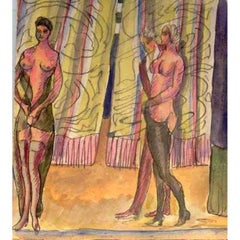
Dancers. 1928, paper, mixed technique, 29x18.5 cm

1928

$723.16
$916.2020% Off
£545.37
£681.2820% Off
€640VAT Included
€80020% Off
CA$1,031.22
CA$1,293.3720% Off
A$1,057.34
A$1,323.3120% Off
CHF 602.43
CHF 750.6220% Off
MX$13,459.03
MX$16,962.0220% Off
NOK 6,919.85
NOK 8,608.0920% Off
SEK 7,219.90
SEK 8,972.4020% Off
DKK 4,879.82
DKK 6,099.6720% Off

About the Item

Adolfs Zardins (1890 08 II Riga, Latvia – 1967 07 II Jurmala, Latvia), painter. Only in 1990 his relatives give his artistic heritage to publicity. “I am 58, and in five Years my colors and lines will be genuinely perfect…” “I don’t obey anything expert myself and my time…” Indeed, he strictly followed this rule, set up by himself; he lived and created as an outsider, obeying only himself and his time, more accurately – his inner time. And he died without being known and acknowledged by his contemporaries. Adolfs Zardinsh – an artist whose creative work has no analogues in Latvian art history of the XX century. This may seem strange, but may seem strange, but maybe it is only natural that we have only fragmentary information about his life. The beginnings are to be sought during the WWI when the family of his father, Peteris Zardins, moved from Vecpiebalga (Latvia) to Vitebsk (Russia). There is a reason to assume that the development of the artistic personality of young Adolfs Zardinsh was influenced by the bustling art life in Vitebsk. As we know, after October 1917, there lived and worked such artists as Marc Chagall, Kazimir Malevich, Mstislav Dobuzhinski, Robert Falk, Janis Tillbergs, a. o. So, it might not be a coincidence that art critics have discovered the influence of M. Chagall in A. Zardinsh’ art works. About 1920, after his return from Vitebsk to Latvia, A. Zardinsh settles down at his sister’s place not far from Riga, at the Riga Bay, and stays there until the and of his days, leading a solitary life and creating frescoes, histrionic compositions, landscapes, portraits. Participation at there exhibitions of the Independent Artist’s union in Riga (1931, 1933, 1935) doesn’t make him famous or acknowledged. His friendship with the Lithuanian painter Vladas Eidukiavicius doesn’t help Adolf Zardinsh to enter the established artistic circle. He still stays the stubborn hermit whose authorities in art are Rembrandt and Velasquez. He takes over some stylistic elements from his favorite art styles French fauvists, German expressionists, Russian neo – primitivisms. Nothing can divert him from his way - neither the fare with destroys many works, nor the deep poverty verging on hunger. If tacking money for good paints, the artist used the ones he has, if there is no paper or canvas, he paint on any background, frugally and carefully. If the composition does not satisfy him, he cuts the ready work in pieces and, using them, creates a new one. His themes stay the years – high society, casino and theatre, genre scenes and erotica. Year by year the art works by A. Zardinsh turn move refined, his compositions – more harmonious, the choice of colors – more perfect. Many of his works can easily compete with masterpieces seen at famous museums. He drew and painted since childhood, because he was born in a very intelligent family, where education was respected. His father dead at artist’s childhood and mother with 6 children moved to Vitebsk (1910 – 1917). In 1920, Zardins with his family returned to Riga. He attended the Studio of Independent Artists and took part at all exhibitions, which were organised by this studio (1931, 1933, 1935). During these years, he painted a lot and draw with aquarelle and pastel small pictures and wrote idiomatic “diary”. After the 2nd World War he lived in cold and hunger, without decent materials for work. He is an individualist who lived in his own reality. His works are full of classic themes (history, mythology, religion and erotics) but interpretation is paradoxical, associative, allegoric and also subjective. Zardins in his works created so-called “individual mythology”. Exhibitions: 1931, 1933 and 1935 – group exhibitions of the Union of the Independent Artists; Memorial exhibitions: 1998 – Riga; 1999 – Germany (Veclara) 1999 – Moscow, Pushkin State Museum of Fine Arts. 2006 – Italy 2019 - In Bucharest, at the main building of the Titulescu Foundation „Adolfs Zardins” Catalogue. A.S. Pushkin of Fine art, Moscow, 1999, – Riga: R.: Neputns, 1999. ; L. Pestova „Adolfs Zardins”, Riga.: Neputns, 2004.
  • Creator:
    Adolfs Zardinsh (1890 - 1967, Latvian)
  • Creation Year:
    1928
  • Dimensions:
    Height: 29 in (73.66 cm)Width: 18.5 in (46.99 cm)
  • Medium:
  • Movement & Style:
  • Period:
  • Framing:
    Framing Options Available
  • Condition:
  • Gallery Location:
    Riga, LV
  • Reference Number:
    1stDibs: LU1437214880632

More From This Seller

View All
Dancer. 1932, paper, mixed technique, 26.5x19 cm

Dancer. 1932, paper, mixed technique, 26.5x19 cm

By Adolfs Zardinsh

Located in Riga, LV

Adolfs Zardins (1890 08 II Riga, Latvia – 1967 07 II Jurmala, Latvia), painter. Only in 1990 his relatives give his artistic heritage to publicity. “I am 58, and in five Years my c...

Category

1930s Abstract Figurative Drawings and Watercolors

Materials

Paper

Dancing figures.  1935, paper, mixed technique, 26.4x18.8 cm

Dancing figures. 1935, paper, mixed technique, 26.4x18.8 cm

By Adolfs Zardinsh

Located in Riga, LV

Adolfs Zardins (1890 08 II Riga, Latvia – 1967 07 II Jurmala, Latvia), painter. Only in 1990 his relatives give his artistic heritage to publicity. “I am 58, and in five Years my c...

Category

1930s Impressionist Nude Drawings and Watercolors

Materials

Paper

Box. 1928, paper, mixed technique, 28x16.5 cm

Box. 1928, paper, mixed technique, 28x16.5 cm

By Adolfs Zardinsh

Located in Riga, LV

Adolfs Zardins (1890 08 II Riga, Latvia – 1967 07 II Jurmala, Latvia), painter. Only in 1990 his relatives give his artistic heritage to publicity. “I am 58, and in five Years my c...

Category

1920s Abstract Figurative Drawings and Watercolors

Materials

Paper

Gobelin. 1943, paper, mixed technique, 11.9x10.6 cm

Gobelin. 1943, paper, mixed technique, 11.9x10.6 cm

By Adolfs Zardinsh

Located in Riga, LV

Adolfs Zardins (1890 08 II Riga, Latvia – 1967 07 II Jurmala, Latvia), painter. Only in 1990 his relatives give his artistic heritage to publicity. “I am 58, and in five Years my c...

Category

1940s Abstract Nude Drawings and Watercolors

Materials

Paper

Intimate views. 1949, paper, mixed technique, 13.5x12.7 cm

Intimate views. 1949, paper, mixed technique, 13.5x12.7 cm

By Adolfs Zardinsh

Located in Riga, LV

Adolfs Zardins (1890 08 II Riga, Latvia – 1967 07 II Jurmala, Latvia), painter. Only in 1990 his relatives give his artistic heritage to publicity. “I am 58, and in five Years my c...

Category

1940s Abstract Abstract Drawings and Watercolors

Materials

Paper

You May Also Like

Figures - Original Watercolor on Paper - 1920s

Figures - Original Watercolor on Paper - 1920s

Located in Roma, IT

Figures is an original artwork realized by a French artist in the 1920s. Original watercolor on cardboard. The signature of the artist is present on the lower right corner in penc...

Category

1920s Figurative Drawings and Watercolors

Materials

Watercolor

The Meeting -  Drawing by Hermann Paul - Early 20th Century

The Meeting - Drawing by Hermann Paul - Early 20th Century

By Hermann Paul

Located in Roma, IT

The Meeting is an Original China Ink Drawing realized by Hermann Paul (France, 1864-1940). Good condition on a white paper. Hand-signed and titled on the lower margin. Hermann Re...

Category

Early 20th Century Modern Figurative Drawings and Watercolors

Materials

Paper, Ink

Couple - Original Watercolour by Jean Delpech - Mid 20th century

Couple - Original Watercolour by Jean Delpech - Mid 20th century

By Jean Delpech

Located in Roma, IT

Couple is an original drawing in watercolor, realized in the Mid-20th Century by Jean Delpech (1916-1988). Good conditions. Jean-Raymond Delpech (1988-1916) is a French painte...

Category

Mid-20th Century Modern Landscape Drawings and Watercolors

Materials

Watercolor

Deco Dancing Hungarian Expressionism European Drawing Modernism Figurative Dance

Deco Dancing Hungarian Expressionism European Drawing Modernism Figurative Dance

By Hugó Scheiber

Located in New York, NY

Deco Dancing Hungarian Expressionism European Drawing Modernism Figurative Dance. 22 1/2 x 16 inches. Signed lower left. Framed. BIO Hugó Scheiber was born in Budapest in 1873. At the age of eight, he moved with his family from Budapest to Vienna. In 1898, to help support his family after they had returned to Budapest. He started working during the day, attending painting classes at the Commercial Art School in the evening. In 1900, he completed his studies. Scheiber showed an early interest in German Expressionism and Futurism. In 1915 he met Marinetti, who invited him to join the Futurist movement. Because Scheiber's paintings conflicted with academic style of the Hungarian art establishment, his work was virtually ignored in his own country. In 1919, he and his friend Béla Kádár held an exhibition organized by Hévesy in Vienna, which was a great success, so much so that the Budapest Art Museum purchased two of his drawings. In 1920, Scheiber returned to Vienna. A turning point in his career came in 1921 when Herwarth Walden, founder of Germany's leading avant-garde periodical, Der Sturm...

Category

1920s Art Deco Figurative Drawings and Watercolors

Materials

Paper, Gouache